Structured Refeed After a 5+ Day Dry Fast
(Updated November 2025)
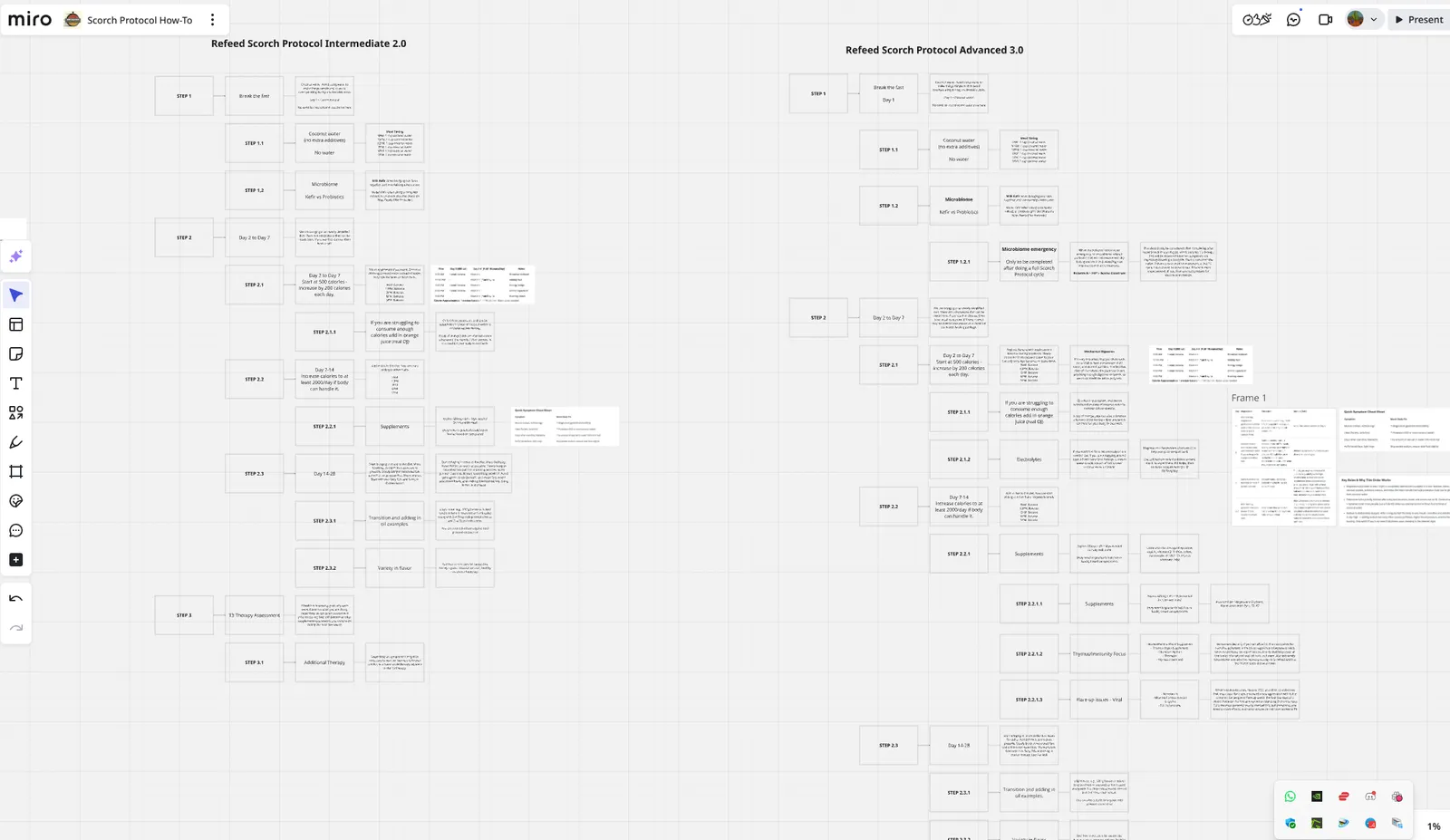
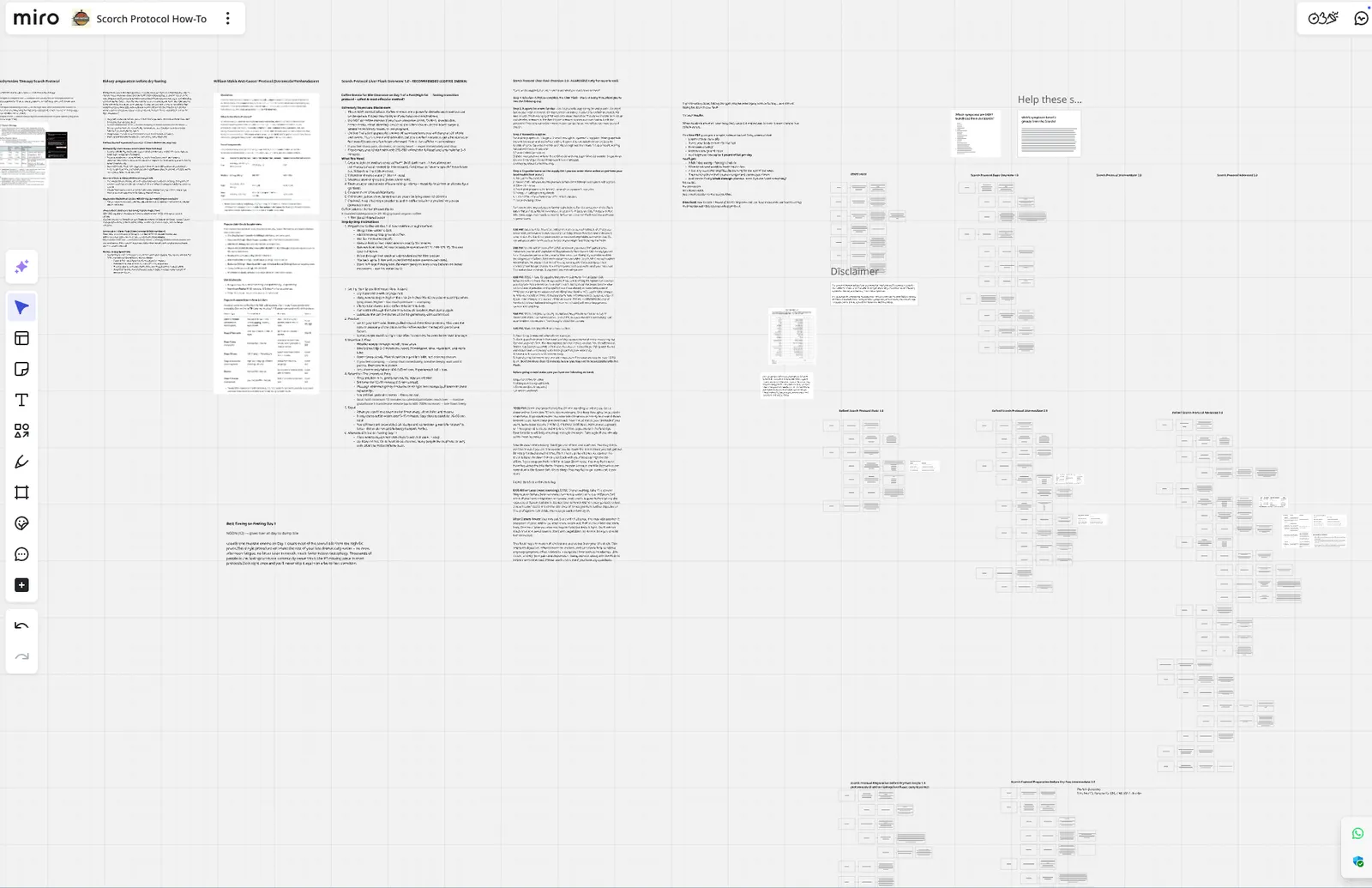
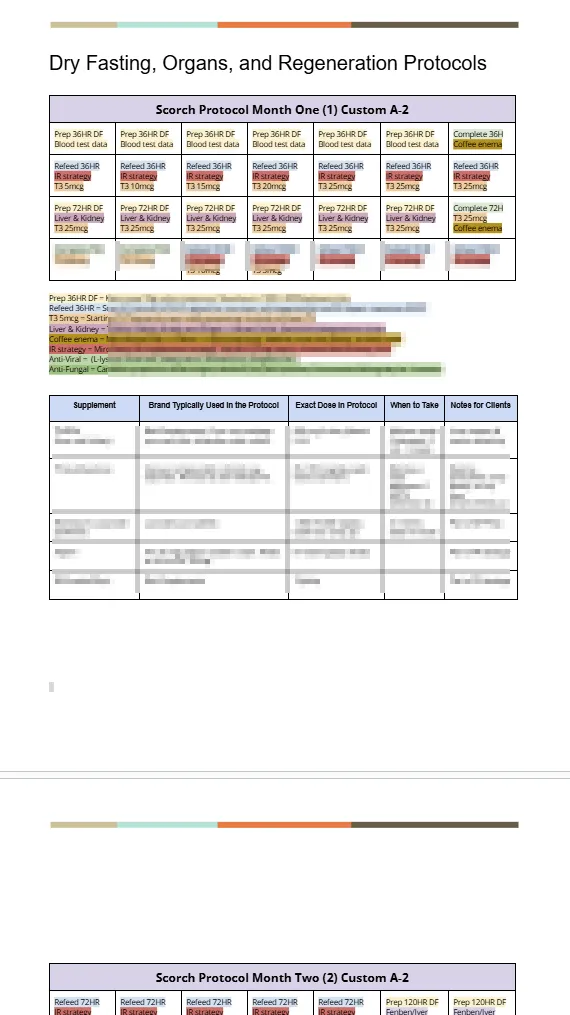
Miro Board Link - Updated Refeeds, Preps, and Protocols. Click Below.
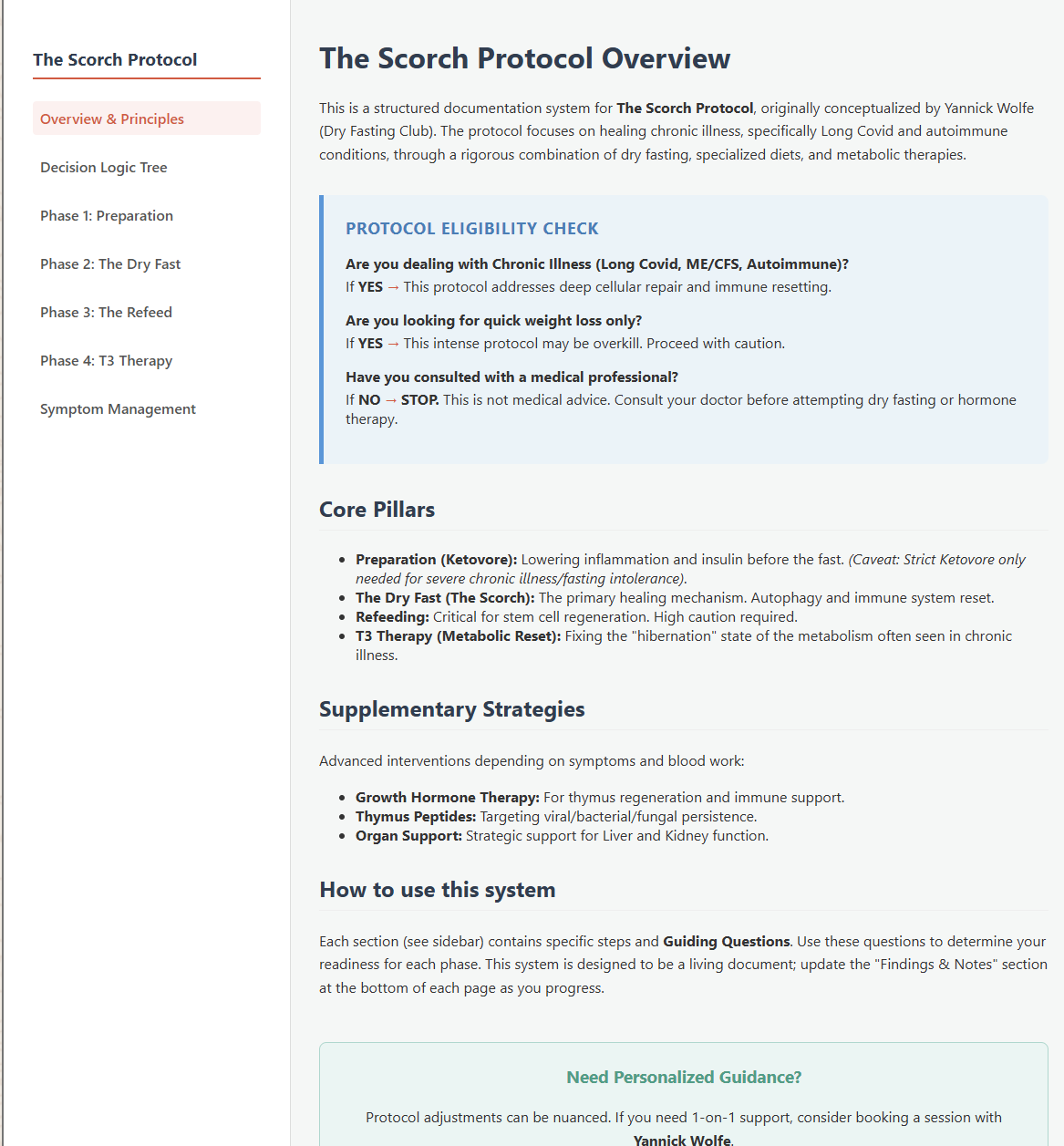
This is a structured documentation system for The Scorch Protocol, originally conceptualized by Yannick Wolfe (Dry Fasting Club). The protocol focuses on healing chronic illness, specifically Long Covid and autoimmune conditions, through a rigorous combination of dry fasting, specialized diets, and metabolic therapies.
MEDICAL DISCLAIMER (READ FIRST)
This protocol involves prolonged fasting, off-label use of prescription medications (liothyronine/T3, ivermectin, peptides, etc.), extreme calorie restriction, and advanced supplementation. Refeeding syndrome, electrolyte imbalance, thyroid suppression, and cardiac events are possible. This document is for educational purposes only and is NOT medical advice. You assume full responsibility for your health.
Contraindications (please book a consult if considering):
• Eating disorders
• Pregnancy or breastfeeding
• Kidney failure, heart failure, uncontrolled arrhythmia
• Type 1 diabetes
• Age <18 or >70 without direct physician supervision
• Active cancer: a hard stop for any multi-day dry fast, including the 5+ day fast this refeed follows. A short dry fast, or a longer water fast during treatment where that is allowed, is case by case with me. (Update, October 2026: this line used to make an exception under oncology guidance and named ivermectin and fenbendazole beside it. Neither is a cancer treatment in my protocol. Fenbendazole has no human cancer-efficacy evidence; here it is an antiparasitic only, with a liver panel before and after the course.)
──────────────────────────────────
Goal of the Refeed Scorch Protocol
To break a 5+ day dry fast with minimal inflammation, zero refeeding syndrome, rapid microbiome restoration, and maximum metabolic/thyroid rebound, while keeping fat regain near zero for the first 4 to 6 weeks.
──────────────────────────────────
STEP 1: Break the Fast (Days 1 to 2, liquids only)
Purpose: Gently rehydrate, let the kidneys wake up, and avoid GI shock.
Why? After 5 days with no water, your stomach, intestines and kidneys are asleep. If you gulp water, drink anything rich, or eat food too soon, you can get massive bloating, vomiting, or electrolyte swings.
Update, October 2026: this guide used to put more emphasis on coconut water as the first fluid, partly for its diuretic effect. Over time the data and the cases I have watched showed that was not ideal: a potassium-rich diuretic in the first hours works against the rehydration and risks a potassium spike while the blood is still thick. The sequence below is the corrected one: water, then kompot, then coconut water and broth, then cooked fruit and vegetables, then rice.
Time | Action | Amount | Notes |
|---|---|---|---|
Day 1, hours 0 to 4 | Plain water only, room temperature, small sips | About a cup (200 to 250 ml) an hour, 1 L at most over the four hours | No gulping. Nothing else until you are urinating normally |
Day 1, after hour 4 | Kompot joins (a small amount of fruit simmered in a large pot of water, strained, no sugar, cooled to room temperature) | Never more than a cup an hour | Day 1 total about 2.5 L across water and kompot. It should taste like faintly flavored water, not juice |
Day 1, evening (about 12 hours after the first water) | Only if a diuretic kick-start is clearly needed: a small unsweetened coconut water | Start very small: 250 ml in an hour at most, 500 ml for the day | Not routine. Coconut water earns its place on day 2, not day 1 |
Day 2, all day | Kompot + unsweetened coconut water (no additives, no sugar added) + broth with no added salt (vegetable broth, or bone broth, unsalted) | Coconut water 1 L at most, still a cup an hour; kompot and broth at the same pace | Still liquids only. No food until day 3 |
NO gulping. NO food until day 3. NO salt.
──────────────────────────────────
STEP 1.1: Electrolytes Day 1 to 7 (Critical Section)
After a long dry fast, the body is low on potassium and magnesium but still holding sodium. Adding sodium too soon = puffy hands and higher blood pressure.
Day | Magnesium Glycinate | Potassium Sources | Sodium (Salt) |
|---|---|---|---|
1 | 200 to 300 mg at night (safe & encouraged) | Kompot only. No coconut water on day 1 unless a diuretic kick-start is clearly needed (see above) | ZERO added sodium |
2 | 400 to 600 mg split am/pm | Kompot + small coconut water (1 L max) + unsalted broth. No KCl yet | Still zero unless dizzy on standing |
3 | 600 to 800 mg split | Cooked fruit and vegetables + kompot. KCl as a light seasoning from today, not before | First day you may add a pinch of sea salt only if light-headed |
4 to 7 | 600 to 1000 mg split (bowel tolerance is the limit) | Food + ½ to 1 tsp KCl daily if needed | Slowly increase only if orthostatic hypotension persists (most people need almost none the first week) |
Magnesium on Day 1 night
200 to 300 mg magnesium glycinate → relaxes muscles, calms heart, prevents cramps tomorrow.
Quick Symptom Fix Table
Symptom | Fix |
|---|---|
Cramps, restless legs | ↑ Magnesium glycinate immediately |
Heart flutters, twitching | ↑ Potassium (KCl or more coconut water) |
Dizzy when standing | Tiny pinch sea salt in water |
Puffy hands/face | Stop all added sodium immediately |
──────────────────────────────────
STEP 2: Early Refeed (Day 3 to 28)
Day 3 to 7: Mechanical digestion + ultra-low residue
Day | Calories | Base Foods | Example Schedule (adjust to hunger) |
|---|---|---|---|
3 | Low: first solids | Cooked fruit (baked banana, applesauce) + soft cooked vegetables, small portions | First solid food. The calorie climb begins here; 5 small meals, nothing salted |
4 to 7 | +200/day | White rice joins on day 4; cooked fruit + vegetables + rice as the base; optional orange juice if struggling | Aim for 1500 to 2200 by Day 7 |
Why slow calories? Fast calories = insulin spike = instant fat regain and inflammation.
Rules
- Chew every bite until it's liquid (salivary enzymes are your only digestive enzymes right now).
- You can substitute banana for applesauce if bloating or discomfort from the banana occurs. Make sure to bake the banana for extra digestibility.
- If you can’t hit calories → add fresh orange juice or pineapple juice (real, not from concentrate).
Day 7 to 14: Expand gently
- Add papaya, mango, steamed zucchini, cucumber, small amounts of avocado.
- Rice has been in since day 4; keep it as the main starch.
- Still keep 70 to 80 % bananas + coconut water as the base.
Day 14 to 28: Transition
- Slowly add saturated fats (grass-fed butter, coconut oil, olive oil).
- Light protein: baked white fish, pastured eggs, chicken breast.
- Keep carbs moderate and whole-food based.
This is when metabolism usually explodes upward. (If not, you may need T3 therapy.)
──────────────────────────────────
STEP 2.2: Targeted Support Phases
2.2.1 Supplements (start gently, Day 3 to 7)
Supplement | Dose Example | Reason |
|---|---|---|
Baby aspirin + B1 (benfotiamine) | Aspirin dose set case by case + 300 to 600 mg B1 | Refeeding inflammation & glucose support |
Magnesium glycinate | 600 to 1000 mg total | Calms nervous system |
Alpha lipoic acid, P5P, K2 | Standard doses | Mitochondrial support |
2.2.1.2 Thymus & Immunity (Day 7+)
- Bovine/porcine thymus glandular
- Thymalin, only where your case calls for it: a per-case add-on set with me, never before refeed day 8 (I no longer use Thymosin Alpha-1)
- Bovine colostrum
2.2.1.3 Flare-Ups / Viral (only if needed)
- Monolaurin
- Olive leaf extract
- High-dose L-lysine
- T3 liothyronine (this is the most potent immune rebooter for many)
──────────────────────────────────
STEP 3: T3 Therapy Assessment (Week 3 to 8)
Monitor weekly: resting pulse, morning temperature, energy, mood, sleep. If improving → continue current plan (no need for rushing into T3 therapy).
This low-dose T3 therapy is just to dip your feet in the water and get initial data and feel for the therapy. These are not the proper T3 cycle levels.
If still hypothyroid symptoms → consider T3 (liothyronine) under doctor supervision. Common safe ramp used by experienced fasters.
Day/Week | Dose (split 2 to 4× daily) | Pulse/Temp Rule |
|---|---|---|
1 to 3 | Low, set case by case | Pulse <90 bpm, temp >36.6 °C |
4 to 10 | Small step up, set case by case | Pulse <100 bpm, no heart racing |
11 to 21 | Further small steps, set case by case | Taper when temp stable at 37.0+ °C |
Only exceed low-dose (safe) therapy when you are ready to perform t3 therapy attempting to fix a low-metabolic state that is not responding.
STEP 3.1 Additional Therapy (only if needed)
- Ivermectin/fluconazole combo (parasite/fungal)
- L-Carnitine 1 to 2 g/day
- Korean Red Ginseng (extreme low-energy days only)
- TUDCA for liver/bile flow (no coffee enemas; enemas are not part of the protocol)
──────────────────────────────────
STEP 4: Human Growth Hormone Assessment (around the third cycle, only if needed)
Only if the first two cycles of fasting and T3 have not done enough (food still not tolerated because of insulin resistance, extreme muscle loss, really bad sleep), and once fully refed:
- Labs: IGF-1, fasting insulin, testosterone, DHEA-S
- If low → hGH itself under medical guidance for three to six months, then wean off and give your own production about 30 days to come back; secretagogues (Ipamorelin/CJC-1295) are for waking the pituitary back up, not a substitute.
──────────────────────────────────
Recommended Lab Timeline
Timing | Tests |
|---|---|
Pre-fast baseline | TSH, Free T3, Reverse T3, CBC, CMP, IGF-1, ferritin, lipids |
Day 28 refeed (optional) | CBC, CMP, phosphate, magnesium, potassium, TSH, Free T3 |
Week 6 to 8 (pre-T3 therapy) | Full thyroid panel, IGF-1, fasting insulin, cortisol |
──────────────────────────────────
Daily Checklist: First 14 Days
☐ Sip all fluids slowly
☐ Chew bananas until liquid
☐ Pulse & temperature 3× daily
☐ Bowel movement every 48 h (magnesium citrate if needed; enemas are not part of the protocol)
☐ Sleep 9+ hours
☐ Walking only (no intense exercise or sauna for the first 2 weeks)