The reason I call this the simplest science-backed dry fasting protocol in the world is because it's easy to follow and one of the very few actual published research studies done on dry fasting. It's very simple and has been demonstrated to be safe and effective for all participants. The average age of the dry fasters was 46 with the oldest participant being 66. If you're new to dry fasting or even a veteran of the practice and want a no-fluff, no bs, simple protocol – look no further.
Anthropometric, hemodynamic, metabolic, and renal responses during 5 days of food and water deprivation - PubMed
The intervention of 5 FWD days in 10 healthy adults was found to be safe, decreased weight and all measured circumferences, and improved renal function considerably.
 Ioannis A Papagiannopoulos
The Protocol
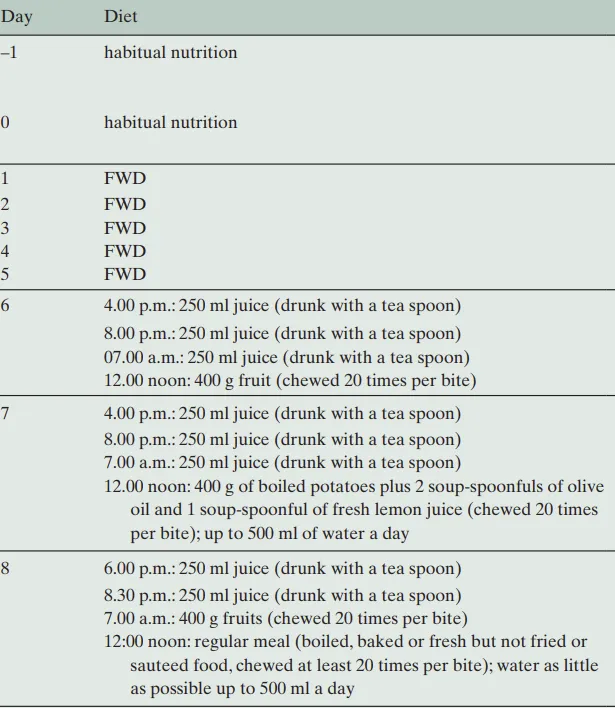
This is ripped directly from the study. It's self-explanatory.
What to keep in mind?
- This protocol assumes habitual nutrition. What is that? We can assume that means a generic whole foods diet, without the absurd amounts of food recognized as "normal" in North America.
- This protocol does not account for people coming from a high-fat low-carb diet, nor does it account for people coming from a high-carb low-fat diet, although if I were to take a guess, I'd assume the diet leaned toward HCLF.
- Slow drinking to avoid binging by using a teaspoon (I recommend this when you break your fasts with water too).
- When eating solid food, it is chewed at least 20 times. We see these recommendations all the time when it comes to breaking fasts. Why? Because our saliva is the first step in the digestive system. A dry fast is the most aggressive fast. It's called a complete fast for a reason. The entire digestive system goes to sleep, and when it awakens, it takes some time for it to rev back up. Saliva includes amylase to break down carbohydrates and lingual lipase for fat. It's important to use this to your advantage to lower digestive distress during the refeed.
- Water is pretty limited in the refeed since you are already getting it from juice and fruit, but if we had to put a number on it, it's around 1.5L per day - which goes against the drink till satiation idea. If you are being very active, this number may vary, but you are not encouraged to do heavy exercise during the refeed unless you were doing very short fasts.
- Salt is being avoided for the first 3 days.
- Fat, in the form of olive oil, comes near the end of day 2.
- The participants only dry fast for Easter once a year, so the idea of refeeding for a minimum of 2x the length of the fast is still highly recommended, if not longer.
- The juice plays into the idea of using Kompote like in Filonov refeeds, just in very small amounts. Kompote should be less sweet than the average fruit juice that you buy at the supermarket.
- Fruit should be fresh fruit and not dried. I would prefer ones high in water content.
- There was no preparation required for the participants, and it seems that their tradition does not include a prep. It would make sense to eat easier-to-digest foods for at least a day before the fast, and you can always use longer dry fast strategies like magnesium citrate flushes. However these were healthy individuals, so if you suffer with digestive disorders or dysfunctional gut motility, then you should take the prep a little more seriously.
💡If you follow my work you'll notice that I talk about the pancreas a lot and with it a renewed focus on insulin resistance. We know that the pancreas does not work optimally for most people hence insulin resistance and downstream effects. Most of my approaches try to target this. A recent Chinese experiment reversed type 2 diabetes by injecting a patient with a new form of stem cell therapy targeted at the pancreas. This is very promising and also shows why mechanisms like stem cell regeneration from a dry fast work. But remember, it only works if you refeed correctly and allow the process to restart gradually and without stress. Binge-ing can have an adverse effect on the pancreas. Sometimes it can take multiple fasts to achieve the level of stem cell regeneration your organs need, but the refeed is still the most important part.
Stem cell therapy cures man with type 2 diabetes, Chinese study claims
A man has been cured of type 2 diabetes for the first…
 Conor Seery
💡My most aggressive and up-to-date protocol for chronic illness is called the Scorch Protocol. Check it out.